Morning pages, journaling, habits.

I admit it: I sometimes struggle to prioritize my writing. There’s the house and the chores and the kids and the husband and the cats and the taxes and the business and… AND the writing. Too often I find myself tired at the end of a long day and not once did I pick up a pen or type something up. And I am furious about it.

So here’s an idea: I need to work on forming the habit of writing more regularly. Urgently! I know I can do it. Heck, there was a time when I got up at 4:45 just so I was ready to write at 5am – proud member of the #5amwritersclub on Twitter. But honest: I’ve not managed that kind of enthusiasm (and masochism) for a long while.

In Autumn 2019 I attended the SCBWI-BI (British Isles) conference in Winchester. I wrote about it here. And at this conference, I listened to Piers Torday‘s “Creating Characters to Care About” presentation. During this talk, Piers mentioned something called Morning Pages and his way of basically employing the well-known journaling method to pump out some prose. Not just in terms of writing something, but also in terms of learning to write no matter the mood of the day.
Of course, I had heard of journaling. Bullet journaling for chore and task tracking, journaling for working through tough times,…but I had never considered to just write unrelated pieces of prose, unconnected prose, a type of association game.

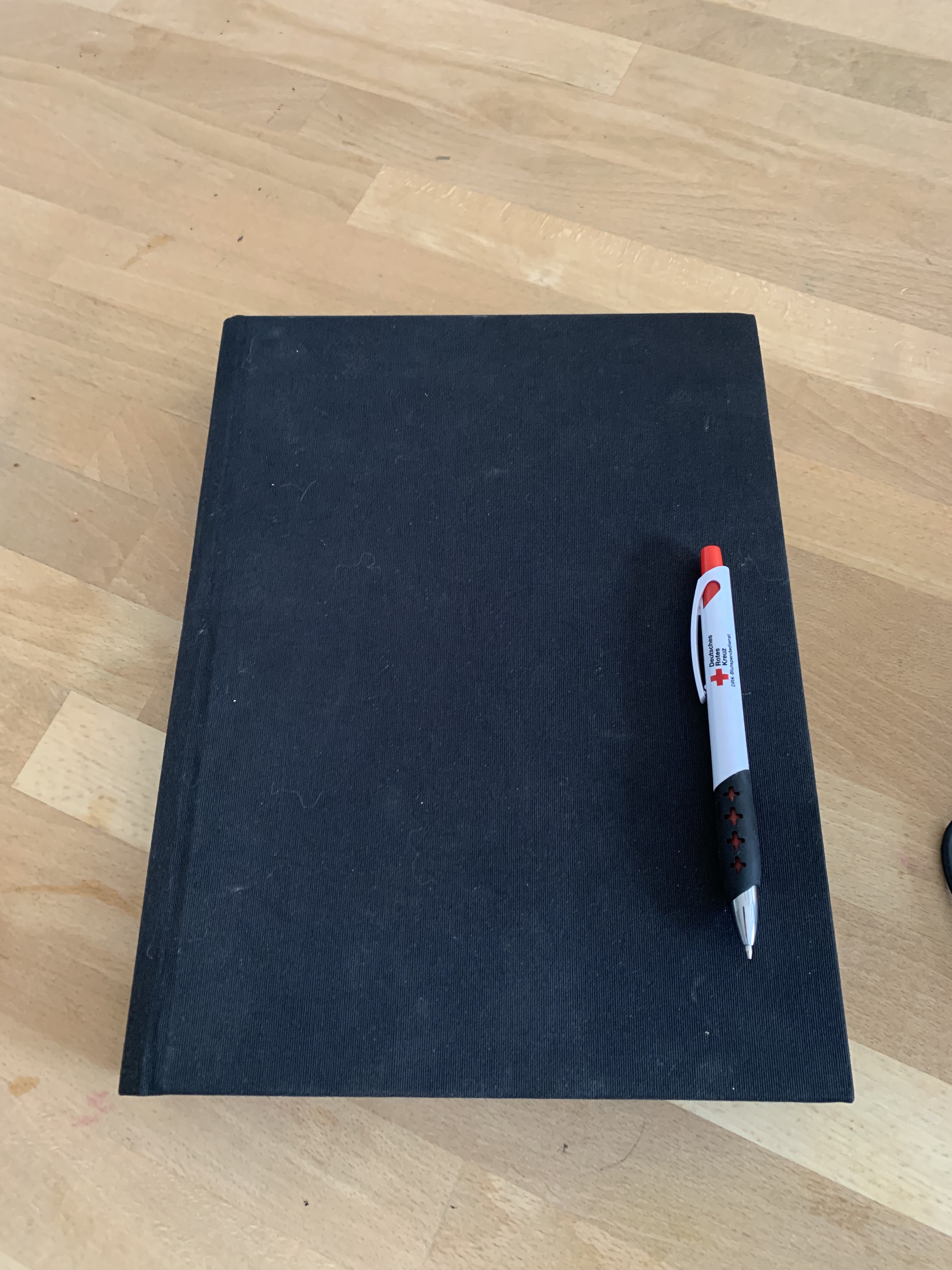
So I went through my stack of unused notebooks and picked just the right one for the job. LARGE! (It’s a DIN A4 size; does anyone outside of Germany even use the DIN norms?) Hard-over. Bound in black fabric. 500 pages. Hahaha. Optimism FTW. I had already written on the first few pages at some other point, but figured 480 pages will be good enough too. Here it is:

I vary the methods from day to day. At some days, I pick up where I left the day before. That’s usually when I draft a short story and am immersed in the plot/story. Other days, I start with a random line – from a book (a bit like the Literary Taxidermy idea, or from my list of ‘this could be a good beginning/first sentence’. Some days I pick a random word. Or an idea/event/titbit I heard on the news and just let my imagination run free: what if…?

So far, I’m not disappointed. 🙂

Done! And submitted!

Alright, I did it. I finished in time and submitted for the Taxidermy competition. It’s been a ride.

When I realized I’d never manage to squeeze Gainelle Mimosa’s story within the 2000 word constraint, I switched to the Toni Morrison prompt with about 14 days to go. I had an idea, but chances were that I would overthink and overwrite again and not finish in time.

However – I made it! It’s submitted and I already got the confirmation that they received it.

I am somewhat excited. I really like the story, and maybe I get to share news about it here at some point.

Huxley Outgrew the Word Count

Here’s the thing: I am an over-writer.

I can’t help it. It happens. Always. The WIP (which I put in hold for the Taxidermy Short Story Competition) stands at 120k+ words with like 75% written and NO! that’s precisely NOT the length any industry professional would deem appropriate for a YA social Sci-fi novel.

And now the Huxley story (I shared the beginning here) has also grown in scope and depth and sheer number of ideas. I can’t possibly fit it into a 2000-word text. Not. A. Chance. (I mean, I maybe could, but I don’t want to cut half of my ideas for Gainelle Mimosa, spy extraordinaire, and her path to freedom)

So, what’s next, you ask? Well, there’s the other, the Toni Morrison prompt from her work Beloved. I am thinking about switching and give it a try. The brackets that I need to fill with a new story are:

124 was spiteful.
[...]
Beloved

I might have an idea for that prompt, but only about two weeks left. That’s going to be tricky. Wish me luck!

Taxidermy. But with stories.

So, I found out about this competition called Literary Taxidermy in 2018 – and what can I say? It just had to be fun! You all go and check it out here: The Lit Taxidermy website and see for yourselves.

So, in 2018 I started writing for one (of the three available) assignments, Lewis Caroll’s Through the Looking Glass, but didn’t finish in time. In 2019 is somehow missed the assignment or maybe hadn’t had the time to try my hands on the Ray Bradbury prompt. But now, in 2020, the competition is back with two new possible prompts: Adolus Huxley’s Brave New World and Toni Morrison’s Beloved.

I think, I’ll go with the Huxley prompt. It’s feels like it will fit right in with my SciFi-ish kind of stories. Here’s the first try on a first paragraph:

A squat grey building of only thirty-four stories in the shadow of a city spire wasn’t the hideout Gainelle Mimosa had expected the most notorious fence anywhere in the next fifty square ligues would choose. The place’s ramshackle security features were even worse than the location: cheap sweepercams at the front gate, the security shutter hanging at an angle and refusing to roll all the way up, and the bulky outline of a WeWhiz 700S detector combo right behind the threshold. Surprisingly cheap, battered, and outdated for the lair of the most and if Gainelle hated anything, it was surprises.

I’ll see where this start will lead me. And if I’ll finish this time around. Then again, we all know how much a deadline can help with getting things done.

SCBWI Winter Conference 2020

New York City. Finally.

It’s been quite a while since I set foot on American soil – if I remember correctly, my last visit dates back to 2003 – a couple of years before I had my daughters – but even then I never made it to The Big Apple.

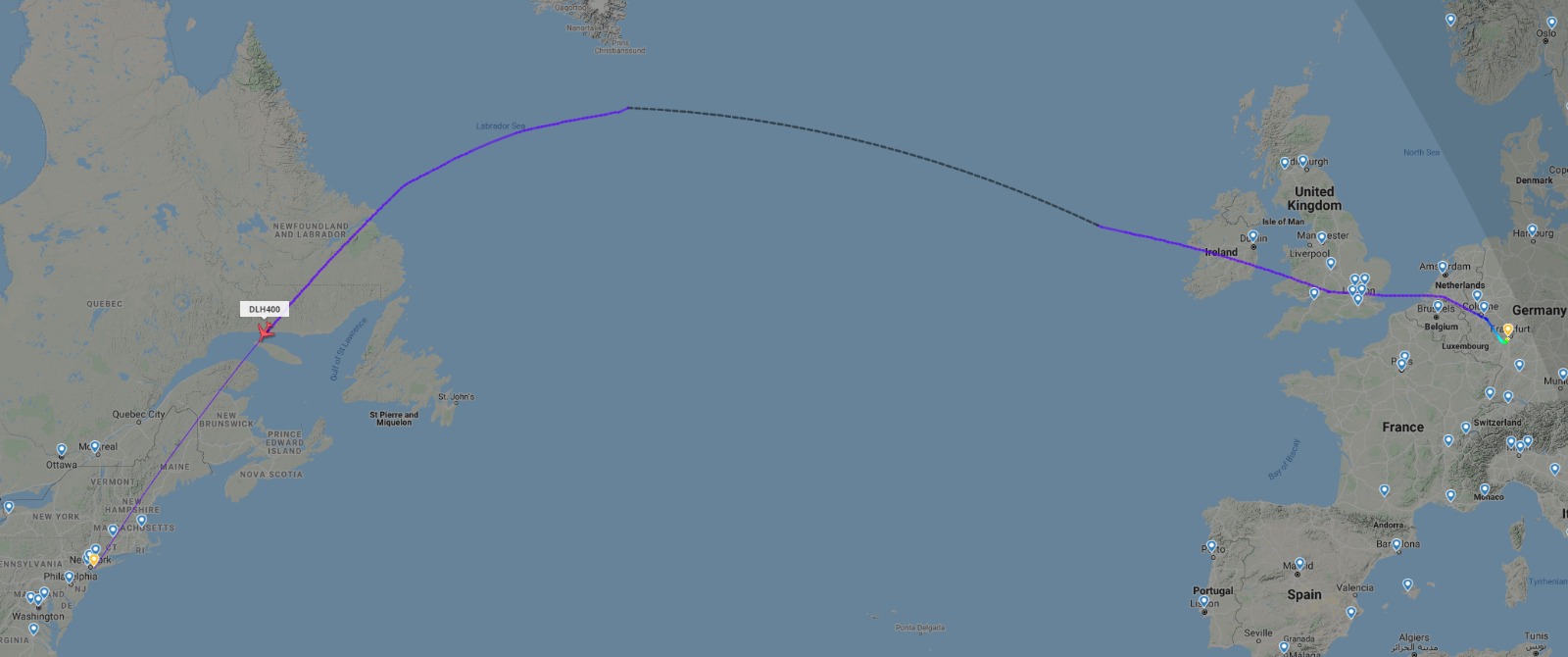
But now, finally, the time had come. Flight from Frankfurt to JFK, Subway to Manhattan – and there I was, ready to meet so many of my fellow Regional Advisors from all over the world, industry professionals, and loads and loads of writers from all over the world. Exciting times!

It’s a long, long way.

In retrospect – and I’m talking weeks here – I’m probably lucky I got to go on this trip. Shortly after returning home, the pandemic hit and first travel restrictions popped up. By now, Germany is in full lockdown.

So yeah, I am glad I got to see NYC. Who knows if I’ll ever be back and if yes, how long it will take.
A few highlights:
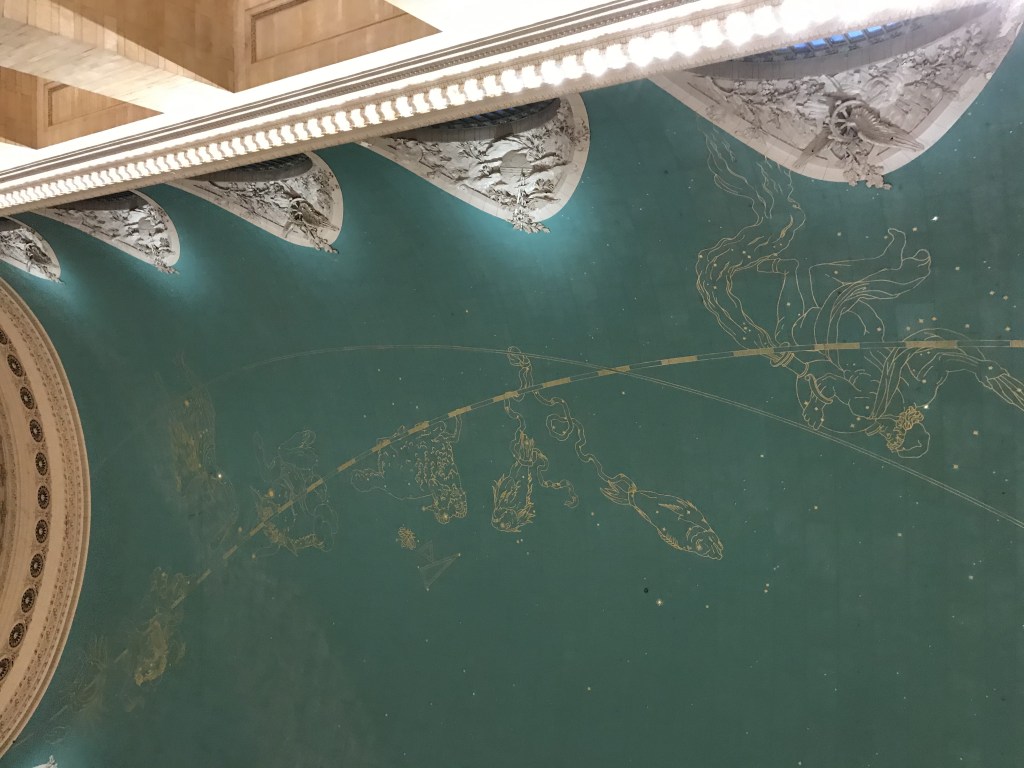
* Grand Central Station. Dang, that’s absolutely pretty!
* exquisite sweets at Ladurée
* Rockefeller Center

Unfortunately, it’s been only a short trip that didn’t leave much wriggle room for more sightseeing, or Broadway, or day trips. So maybe I get to come back and add a couple of days next time.

The main focus was, of course, the conference itself. So many talented people held presentations, lead workshops, and participated in panels – I wish I had been able to split myself up and watch it all. The amount of inspiration and the new skills and idea sets were certainly worth the long travel hours.

Conference Business

Last weekend I attended SCBWI BI’s annual Winchester Conference, the second writing-related conference this year. To put a long story short: I had a blast!

After this year’s Europolitan conference in Zurich–kudos to the regional team of SCBWI Switzerland–I realized was informed that Germany/Austria will be hosting the next Europolitan in two year’s time and I am going to be in charge of organizing it because I’m the Regional Advisor (RA).  (Cue some mild panic.)
I figured I better start looking around ASAP for a) ideas on affordable venues to host the next Europolitan, b) help to get it all sorted, and c) ideas what to do.
Naturally, I arrived at the idea of attending more SCBWI conferences to get a better picture of what can be done, how it’s done, and get some insights from my fellow RA+team who have been around a while. And along came Winchester. And there will be the annual Winter Conference in New York in early 2020. (Can’t wait!)

Pros and Cons from Winchester

On the plus side: the team, all volunteers, the venue, the faculty–well, everyone, really–was amazing. The whole conference was well planned. Talking to Natascha Biebow, I learned there were 200+ attendees, and despite the number of people, everything went like clockwork.
While all the breakout sessions I attended were informative and helpful, I liked the Friday Night Critique best: Feeback on the first 2000 words of my WIP. Neat! Peer feedback is such a crucial part of refining a manuscript! I got paired up with three other YA writers who all submitted super-exciting beginnings. If I had taken up those pages in book form, I would have wanted to read on for all of them.

On the ‘meh’-side – and I am well aware that point does not hold true to many others 😉 –the location is a teeny-tiny bit out of the way for those who don’t live in the UK. Coming from Karlsruhe, Germany, it took me a whole day of travel. (Train to Paris, Eurostar to King’ X, tube to Waterloo Station, train to Winchester; flights to Southampton were basically way beyond my budget) Of course, the time was not entirely lost as I worked on my WIP on the way to the Winchester and jotted down some post-conference notes on the way back. Unfortunately, after a few hours, even the comfiest train seat gets a bit old.

Meeting people

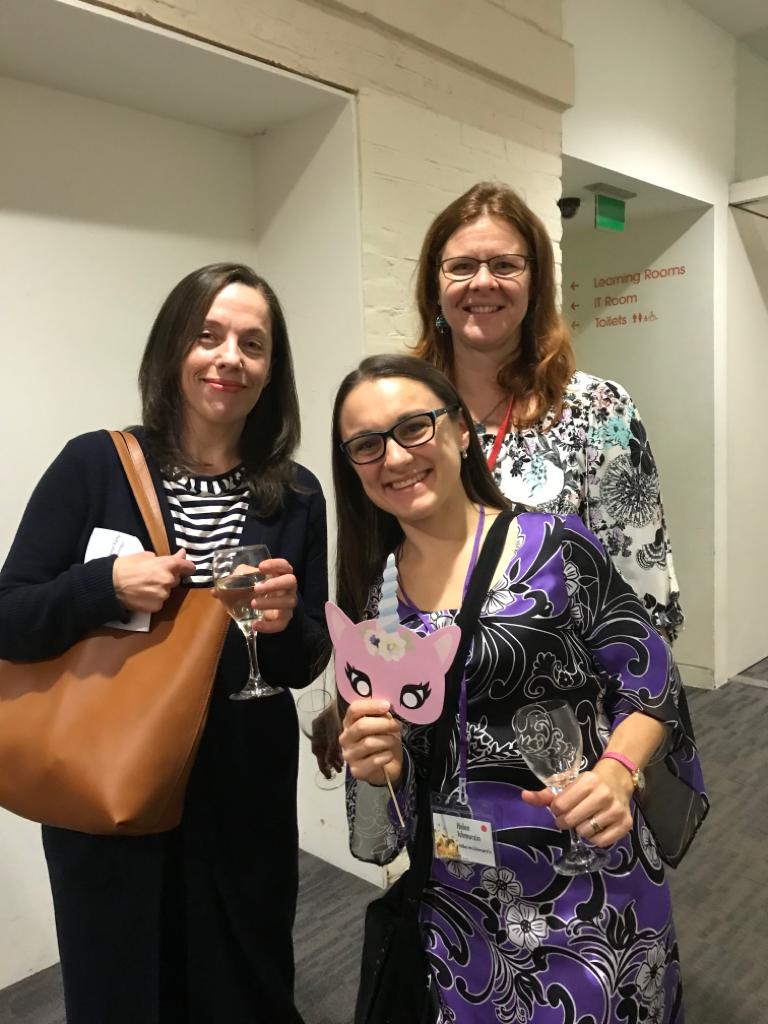
The SCBWI Germany/Austria region covers such a large area, I can’t possibly meet with all members. So, conferences are a perfect opportunity to seek out and meet with those people who you know only via social media. Below, a picture of the three Germany/Austria members in attendance this year. We all met for the first time, and it was great to finally shake hands in RL!

WhatsApp Image 2019-11-06 at 10.51.01.jpegThe brilliant Angela Murray and Helen Ishmurzin at our Ger/AT Region’s network meeting.

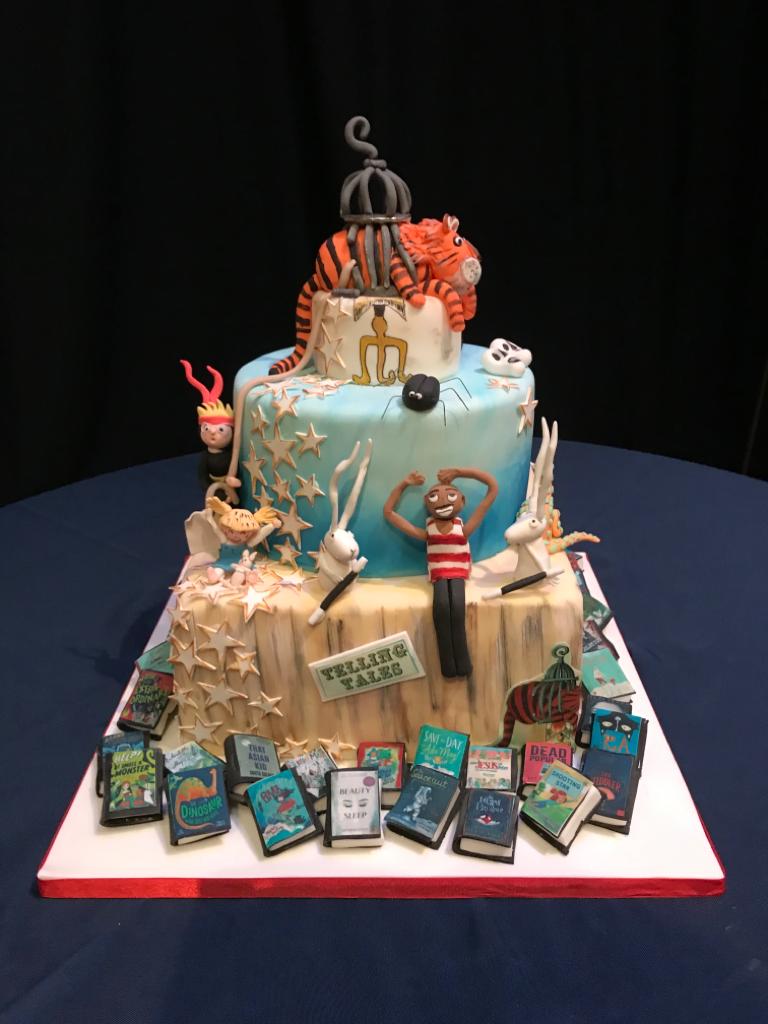
Also: THIS AMAZING CAKE at Saturday’s party, showing all the books of the SCBWI BI region’s mass-book-launch, topped with this year’s conference motto Telling Tales and the illustration/logo as sugar figurine.

WhatsApp Image 2019-11-06 at 10.50.44.jpegUnfortunately, I have no idea whom to credit for this masterpiece of cakemanship…but whoever is responsible: KUDOS! Just look at all these details–it’s amazing.

So, looking back to the past weekend, I am super happy I went to Winchester. I will definitely go again next year if I can manage at all and encourage everyone who is on the fence about attending such an event to go ahead – it’s been a blast.
I took home a few ideas for the Europolitan conference, too, so that’s another win. Yay!

Time to move on…

With SCBWI’s last meet-up in Stuttgart only a few days ago and so many new people to talk to about writing, I have come to a decision: I need to move on to a new project.

Don’t get me wrong, Dire Tidings is not dead. The idea is great. I’ve got awesome characters. I’ve got an intriguing fantasy world. I’ve got plenty ideas for situations, events and conflicts. But I have been working on it for the last 14+ month and I came to realise that the one thing I don’t have is a grip on the plot. At least not in a manner that will have result in success.

The idea grew in several stages and the whole fantasy world has been growing ever since. Honestly, I am overwhelmed. And right now, I am not ready to tackle what will be needed to bring it to a satisfying end.

I do believe that it is healthy to admit to ones own shortcomings. And I do admit to myself: at this point in my writing career I am not ready to pull of such a huge project. Not yet. I lack the skill and the stamina to do it. Simple as that.

So Dire Tidings is on hold for the time being. Sitting there, it will mature and in time I’ll be back to salvage what I can. Certainly, like wine, it will get better over time when non essentials are stripped away and the core of the story will remain.

Not, that I am lost now. A quick look into my idea-book and I’m already set to re-start. I picked up a new idea that feels promising and will start brainstorming possible plots, premises and characters.

Feels good. 🙂


SCBWI Germany

It’s January the First and I tackled an item on my bucket list for 2016. Yay me! There is nothing as motivating as the start of the new year. Don’t you all agree?

In December I talked to Melinda Salisbury – you all should totally check out her blog (http://melindasalisbury.com/) and her first YA book The Sin Eater’s Daughter! She told me about the Society of Children’s Book Writers and Illustrators and since my WIP is going to be YA, too I figured I join them.

And I did. Today. 🙂

I have already been through the website and blog. Hopefully there will be an event near me soon.

Anyways. One thing at a time. And the first “CHECK” on my bucket list.


That was 2015

So, the year is gone and I am nowhere near the result I pictured for this date of the year at the beginning of 2015. In parts this is disappointing. In parts it is .. well understandable.

There are a few things I learned in 2015. The hard way.

  1. I haven’t been able to establish a “regular writing time” for myself.
  2. I am not a “pantser”.
  3. I have a LOT to learn.
  4. It is harder to get valuable critique than I expected.
  5. I seem to forget the proper use of “than vs then” every couple of weeks.

Mind you, that is not _all_ I learned in 2015, but it pretty much sums up the main points that matter to me at this moment. What’s that saying? The first step to solving any problem is recognising there is one. And if I really want to get somewhere with this whole endeavour I better start making up my mind about some changes I can put into place for 2016.

Getting back to the list above I come up with this on the top of my head:

  1. This is a tough one. I have nothing.
  2. If I am not a “pantser”, I might be a “plotter” or anything in between. I realised that weeks ago and took appropriate steps. My bookshelf is bursting with new advice books. I basically stopped working on my WIP and dove into the theoretical and structural guidebook pool. That leads me too..
  3. … I learns LOADS of new stuff. From structure and outlining processes to POV secrets, telling vs. showing – not to mention the vast amount of useful blogs out there. At days I felt like I read _the internet_. Still, there are many many more things to discover.
  4. Critique. Well. Not, that I cope with it poorly. No. I just can’t find the means to get it before someone who could really help me with improving. Sure, family member read my stuff. But there is the family bond that might hinder them in being brutally honest. And there is the language barrier. I need a critique buddy who is a native in English and not a “friend”. I will need to look into this first thing 2016.
  5. Then I can go on improving faster than I did in 2015. (See what I did there?) There might be hope after all.

See you all in 2016. Wonder what it will be like.


Books for writers – advice, tips and tricks

If you read, you learn something new every day.

Currently I am reading How NOT to Write a Novel: 200 Mistakes to avoid at All Costs if You Ever Want to Get Published by Sandra Newman and Howard Mittelmark. Today I finished Part 1 where they describe plot related common mistakes new writers often do. Some of the points they bring up I knew already. Some issues were new to me – or at least I never thought about them in the way they are described and explained. Of course it all makes perfect sense as soon as you read it in the book.

The best points for me – either as new or as a good reminder of something I already knew – were

  • everything I include is my own conscious choice so I better make it count. If I do mention something, it should have some meaning to the story. Otherwise the reader will be disappointed. This includes characters, items, obstacles or other issues I mention
  • if characters got some special traits or abilities which will be important in the plot I can’t wait to the point those become relevant and just dump it on the reader. I will need to weave it in beforehand so it does not come as a “oh – I just save the day with my special skill I never mentioned before now”- moment.
  • I already knew never to repeat information I already gave to the reader. What was new was that I should avoid “scenes with similar settings for a specific issue” too. No déjà vu, please.
  • Don’t dispose of evil adversaries to easily. If they bother my protagonist, they can’t disappear conveniently.
  • Don’t cheat at the end. There are no miracle solutions coming pulled out of thin air. If the lead does not solve the issues in a satisfying way, then the ending is rubbish.

And now – Part two of the book!